





You already did the hard SEO work. Stop paying to rediscover it.
Most SEO teams do not have a recommendation problem. They have a continuity problem. The research happens in one tool. The keyword data lives in another. The strategy gets summarized in a document. AI writes from whatever context made it into the prompt. A developer implements an interpretation. Then the site changes again.



The decision that mattered gets separated from the evidence that justified it.
Every handoff is a chance for strategy to turn into folklore.
A good SEO decision can survive a meeting. It can survive a document. It can even survive a handoff. What it rarely survives is time.
Eventually the site still looks intentional, but nobody can prove it matches the strategy that created it. That is when teams pay twice: once to make the decision, and again to reconstruct it.
One workflow. Every decision keeps its source.
Each stage has a clear actor. What a machine proposes, a human approves. What a human approves, the generated work has to respect. What ships, the verifier checks against the approved decision.
Research
Observe the public site and retain bounded evidence about what is actually there. No “trust me.” No reconstructed memory.
Measure demand
Attach real search measurements to the queries under consideration. A measured zero is not missing provider evidence. Missing evidence is not zero. Unmeasured is not measured.
Propose
Your AI interprets the evidence and demand, then proposes an SEO direction. That judgment is useful. It is also still machine judgment, and Querywright records the difference.
Approve
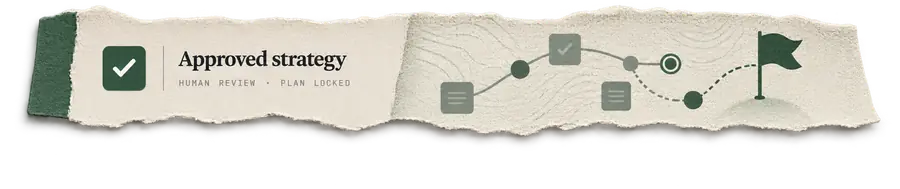
The machine can recommend the change. It cannot approve its own homework. A human accepts the exact strategy that should govern.
Generate
Querywright prepares an authenticated brief: the approved direction, the evidence the writer can rely on, the uncertainty it must preserve, and the claims it must not invent. Your AI writes. The source of truth stays outside the model.
Review
The copy you approved should not vanish into yesterday’s chat. Human-reviewed work becomes a durable artifact with its lineage intact.
Verify
When something breaks, Querywright can tell you what broke, what it was supposed to be, and which approved decision says so. Not just that a score went down.
The machine can recommend the change. It cannot approve its own homework.
A proposal is not an approved strategy. The system keeps those as different artifacts because the distinction matters, and a human accepts the exact strategy that should govern.
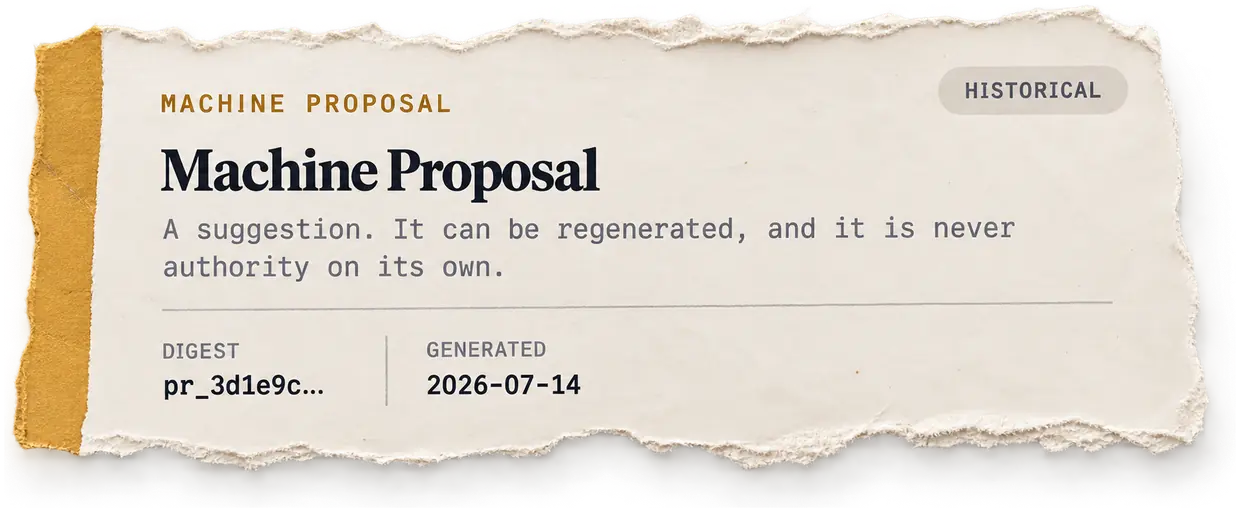
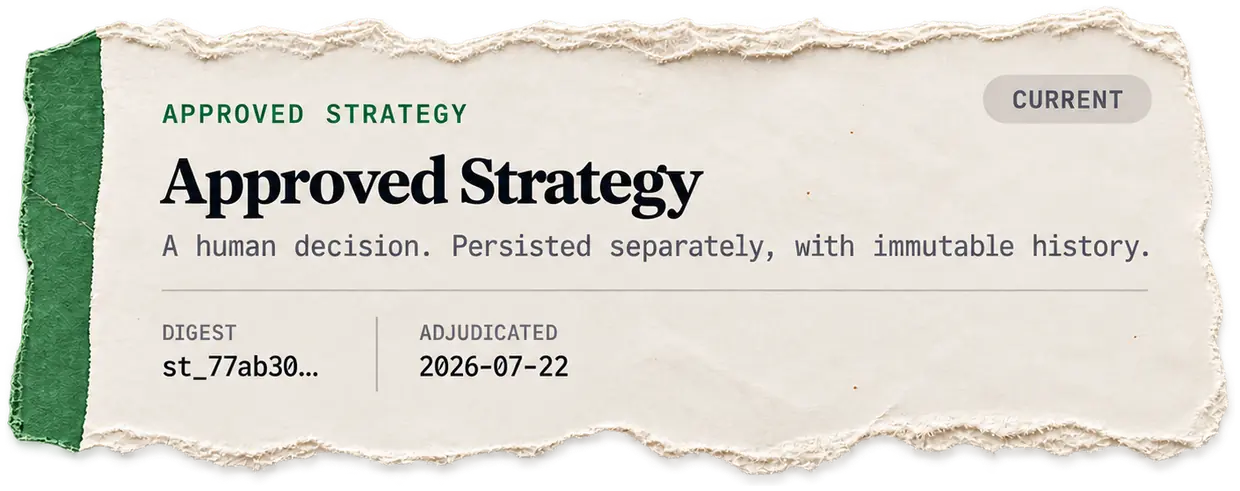
A proposal is a suggestion. An approved strategy is a human decision, persisted separately, with immutable history.
AI makes missing context cheaper to ignore.
That is useful right up until it is dangerous. A human who does not know something usually stops and asks. A model can produce a confident answer anyway.
“I don’t know”becomes“probably.”
“no provider evidence”becomes“zero.”
“the site never established this capability”becomes“this sounds plausible for the product.”
The faster AI gets, the more important the boundary becomes. Querywright gives the model room to reason without giving it permission to rewrite reality.
Host AI · the fuzzy work
- interpreting evidence
- mapping queries to pages
- explaining tradeoffs
- drafting copy
- making semantic judgments
Querywright · the fixed points
- public research
- measured demand
- artifact identity
- authenticity
- approval lineage
- persistence
- deterministic verification
- truthful evidence states
Not more recommendations. Better authority.
Plenty of SEO software can tell you what it thinks you should do. Querywright is built around a different question: what should still be true after the recommendation leaves the tool?
Real measurements stay real
Search demand comes from measured data, not from a model guessing what looks popular.
Machine reasoning stays labeled
A rationale written by your AI can shape the strategy without pretending to be observed evidence.
Human approval changes the state
A proposal is not an approved strategy. The system keeps those as different artifacts because the distinction matters.
Uncertainty survives generation
If the evidence does not establish a claim, generation does not get to quietly upgrade it into a fact.
Verification points backward
A finding can be traced to the authority that made it a finding. The chain survives all the way to the live site.
The interior is the evidence trail.
Querywright is not one opaque answer. It is a sequence of inspectable artifacts, and each one keeps its lineage.
The interior is a desktop layout, so it is not embedded at this width. It is one tap away.
Open the interiorWhat is in the system today.
Only accepted capabilities are listed. Nothing here is a roadmap item wearing a shipped costume.
Research & demand
- Persisted keyword research with observation IDs
- MEASURED_POSITIVE, MEASURED_ZERO, and no-provider evidence kept distinct
- Geography-aware demand
- Provider provenance on every observation
Strategy
- Deterministic proposal generation
- BUILD / SUPPORT / CONCEDE with stated reasons
- Human adjudication, persisted separately
- Modified-and-approved state with immutable history
Verification
- Deterministic rules
- Crawl observations
- Current-authority verification
- Fail-closed corruption handling
- Findings and reconciliation
Evidence
- FIELD, RECORDS, LAB, DERIVED classes
- Active and retracted states
- Derivation lineage
Built for teams where SEO has to survive implementation.
SEO practitioners
You can make the right recommendation and still lose the result if implementation drifts. Querywright keeps the decision attached to the evidence and demand that justified it.
Agencies
The more pages, stakeholders, developers, and handoffs you manage, the more expensive undocumented rationale becomes. Querywright gives complex site architecture a durable decision trail instead of another layer of project memory.
Developers
A vague SEO deck becomes a machine-readable requirement that can be inspected and verified. Less interpretation. Less archaeology.
AI-native teams
If models are already researching, planning, drafting, or reviewing your work, Querywright gives them a grounded system to operate against instead of a growing pile of prompt context.
It is not another place to collect advice.
It does not need to be the tool where every piece of work happens. It is the layer that keeps those pieces connected.
Not
- a generic AI writer
- a keyword dashboard
- a mystery SEO score
- a rank tracker
- just a crawler
- just a recommendation feed
- an agency-management console
What it protects
- What was observed.
- What was measured.
- What the machine proposed.
- What the human approved.
- What was generated.
- What actually shipped.
That is the chain Querywright protects.
Sometimes the correct answer is “we don’t know.”
Querywright preserves uncomfortable states instead of smoothing them away. Verification returns one of these, and each one means exactly what it says.
PASS
A deterministic expectation matched. The check is repeatable with the same inputs.
FAIL
It did not. The finding records the expected value, the observed value, and the authority source.
PENDING
The answer requires human judgment. The system will not settle it by guessing on your behalf.
ERROR
The available evidence is insufficient to establish the state. It does not guess, and it does not average it away.
Stop solving the same SEO decision twice.
When the evidence stays attached to the strategy:
Your AI can move fast without making your strategy disposable.
Querywright turns research, measured demand, human approval, generation, review, and verification into one traceable SEO chain, so the next answer starts from what was already proven instead of starting over.